

Enterprise Ressource Planning (ERP)
The term ERP comes from English « Enterprise Ressource Planning ». ERP has been translated into French by the acronym PGI (Integrated Management Software) and is defined as a group of modules linked to a single database.
ERP is a software package that allows you to manage all of a company's operational processes by integrating several management functions : management solution
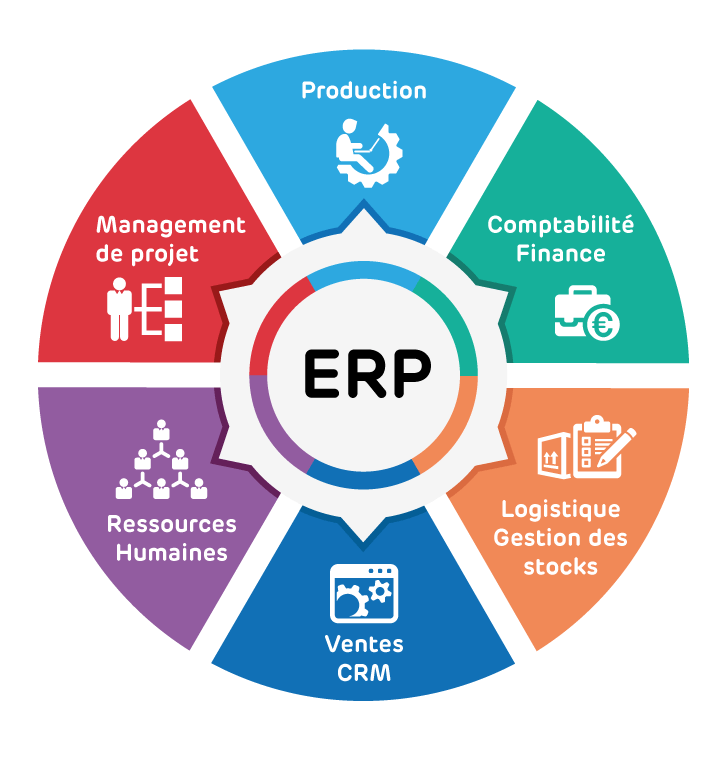
orders, inventory management solution, payroll and accounting management solution, e-commerce management solution, BtoB or BtoC business management solution … in a system. In other words, the ERP represents the « spine » from a company.
To qualify as « Integrated Management Software », an ERP software solution must cover at least two fundamental principles which are as follows :
- Build computer applications in the form of independent but perfectly compatible modules on aunique and common database.
- The use of a Workflow engine makes it possible to define all the tasks of a process and manage their implementation in all the modules of the system that need it.
ERP is management software which allows the company to integrate different functionalities such as :
- Accounting and financial management (Accounting management ERP, Billing management ERP),
- Stock management (ERP inventory management software),
- Human resources management,
- Supplier management (ERP for large-scale suppliers) as well as,
- Sales management,
- Distribution management or,
- The management of e-commerce (ERP commerce, Specialized retail ERP).
In addition to an ERP, and as part of a customer satisfaction approach, many companies also acquire CRM software. This tool allows them to pool and maximize the knowledge of a given client and, so, to better understand, anticipate and manage your needs.
Source: choisirmonerp.com

